Super Bowl Preview Part 2: 49ers Offense vs Chiefs Defense

The 49ers, led by brilliant head coach and play caller Kyle Shanahan, have steamrolled two teams so far in the playoffs. The 49ers offense uses motion to shift the numbers advantage in their favor, opening up holes for their run game and play action.

The 49ers offense uses the run game to set up chunk plays off of play action. Their run game is based on the wide zone. Kyle Shanahan’s father, Mike Shanahan, built his offense off of the same play, winning back to back Super Bowls with the Denver Broncos in 1997 and 1998. On the wide zone play, the offensive line moves in unison and blocks the defender that shows up in their area, rather than a designated man. To run this scheme, you need smaller, athletic lineman, which the 49ers have. They also feature extremely fast running backs, led by Tevin Coleman and Raheem Mostert. There are few running backs who run 4.4 second 40 yard dashes, and the 49ers have 4 of them. Having fast backs benefits the scheme because the backs are asked to make one cut and get up the field.

The Chiefs defense was their downfall in the playoffs in 2018, failing to stop the Patriots in the AFC Championship game last year. Andy Reid fired Bob Sutton and replaced him with Steve Spagnuolo, who is known for his exotic blitzes and complex coverages. Sutton’s defensive scheme was very vanilla, and Reid knew he needed to make a change. The Chiefs defense is led by star defensive lineman Chris Jones, Safety Tyrann Mathieu and defensive end Frank Clark. Mathieu is the most important part of the defense because his responsibility is to get the defense lined up. In Spagnuolo’s complex defense, there are many checks which Mathieu has to communicate on the field to his teammates.

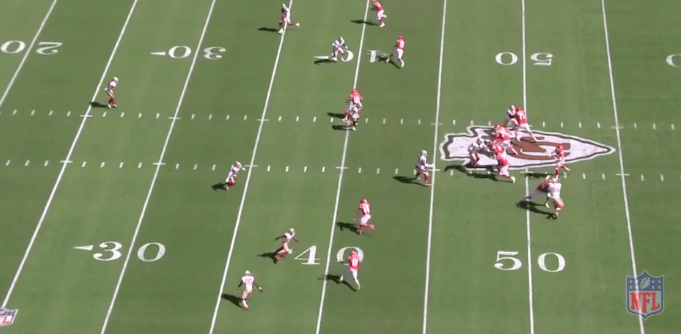
Against the Green Bay Packers, the 49ers faced a 3rd and 8. The Packers lined up in their diamond front, which has 5 defensive players across the line of scrimmage, usually some standing up. instead of throwing on 3rd and 8, like most coaches would do, Shanahan dials up a run to the short side of the field, pulling the onside guard. Against the diamond front, all the running back has to do is clear the first level, and he is gone. Mostert cleared the first level with ease, taking it in for a TD.
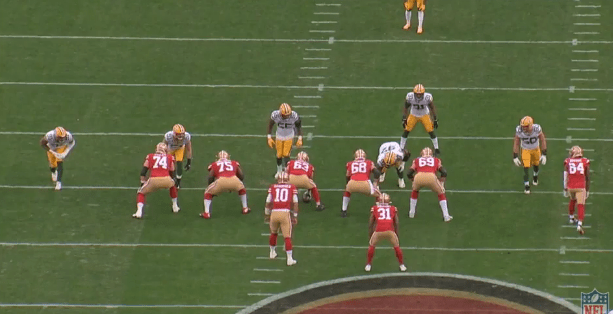
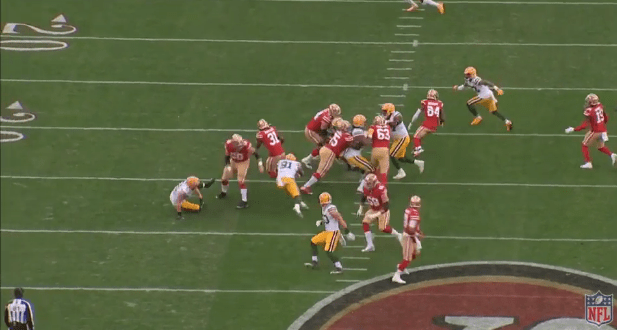
2019 Packers @ 49ers Quarter 1 6:01

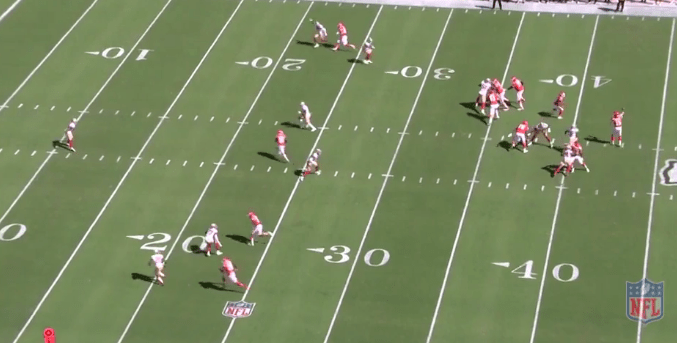
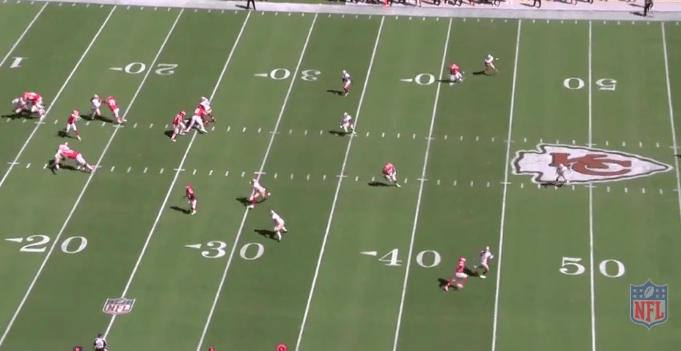
The Chiefs played the Titans in the Championship Game. Derrick Henry ran through the Ravens and the Patriots to get to the third round of the playoffs, essentially carrying the team on his back. The titans run a zone scheme similar to the 49ers. In the play below, the Chiefs play a 4-3 base single high defense, against the Titans wide zone out of 21 personnel, a personnel grouping the 49ers use frequently.
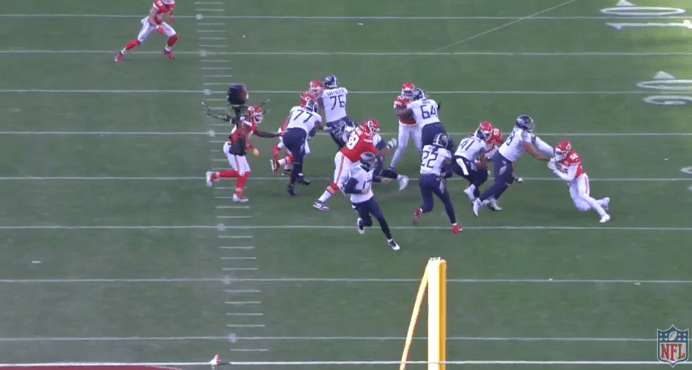
2019 Titans @ Chiefs Quarter 1 8:35

The Chiefs linebackers do a good job of scraping overtop, to the play side, gaining leverage. The nose tackle (#98) is able to shed the center’s block, allowing him to close ground and tackle Henry.

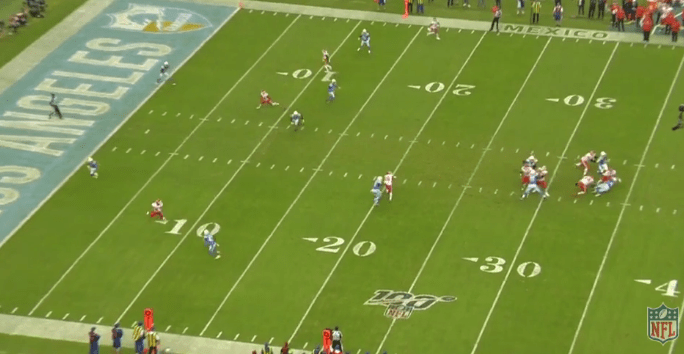
In the second quarter, the Titans run another wide zone play out of 21 personnel. The Chiefs use a run stunt, with #94 going inside, to try and blow up the play. Safety Daniel Sorensen (#49) aggressively fits in the C gap, which was vacated by #94 when he stunted inside to the B gap.
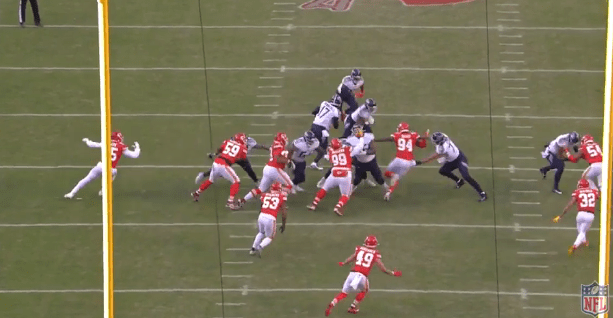
2019 Titans @ Chiefs Quarter 1 8:35

The 49ers run game will be tough to stop, but if the Chiefs get the 49ers into 3rd and long, they’ll come after the 49ers and Quarterback Jimmy Garoppolo with simulated pressures and disguise their coverages. In the divisional round against the Houston Texans, the Chiefs show a Cover 0 blitz, to make the Texans think they are bringing pressure. At the snap, they drop out and force Quarterback DeShaun Watson to hold the ball. They play Cover 2 Invert, with the safeties playing the flats and both outside corners covering a deep half of the field.
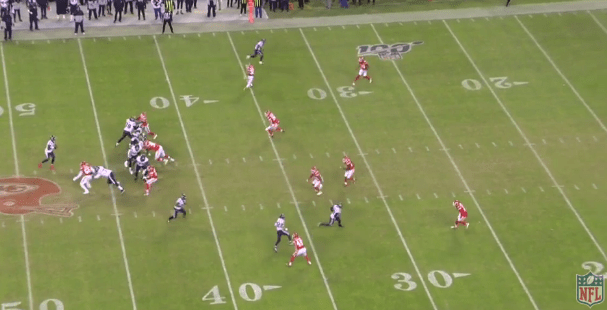
The 49ers hope to be able to stay out of 3rd and long so the Chiefs can’t unleash their disguised coverages and simulated pressures on them. To do that, they’ll have to run the ball well, which is something they’ve excelled at all season. The first run we’ll look at is against the Minnesota Vikings. They run wide zone right out of 21 personnel. The fullback (#44) sifts, which means he cuts off the backside edge defender. The offensive line maintaining outside leverage on their blocks, allowing Mostert to take the ball to the edge for a solid gain of 8 yards.
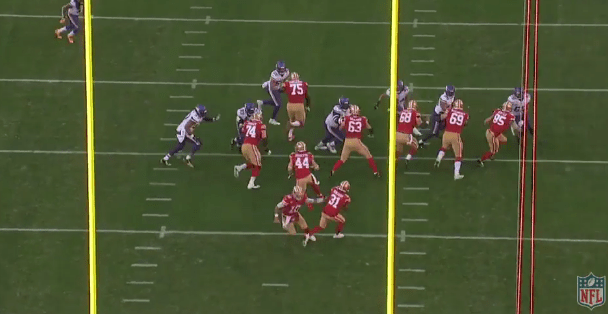
Later in the game, the 49ers run the same play out of the same personnel grouping. This time they add ghost motion, which means a receiver running behind the quarterback at the snap. The ghost motion forces the linebacker (#50) to go too far wide, allowing the receiver to block him and leaving a huge cutback lane for the running back. Shanahan makes the defense think it is the exact same play as before, but dresses it up with the motion. The running back reads it and sees the cutback lane.
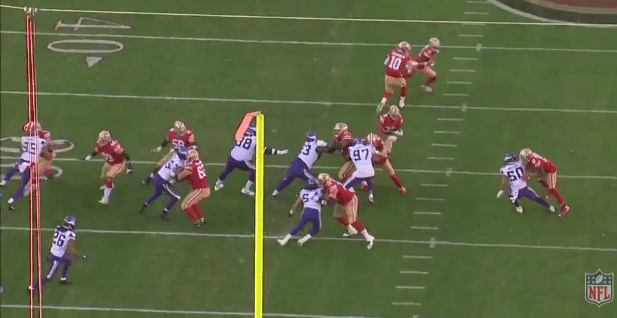
Kyle Shanahan’s brilliance in the run game will be tough to stop. The chiefs must stay disciplined because Shanahan will try to manipulate them by showing them something they think they’ve already seen, but giving them something slightly different. One defender in the wrong gap can result in a big play, due to the 49ers speed at running back and receiver. Additionally, The Chiefs will have to come up with a plan to stop tight end George Kittle, who is an elite receiver but also a very good blocker. Look for Shanahan to find creative ways to get him the ball. The Chiefs know they have to limit the run for two reasons. One, if the 49ers can establish the run, they’ll sustain long drives and keep the chiefs explosive offense off the field. Two, the chiefs will be able to confuse Garoppolo with their exotic looks on third down. The 49ers must score to keep pace with the chiefs. If they chiefs can play well defensively, they should go home with a Lombardi trophy.
Super Bowl Preview Part 1: Chiefs Offense vs 49ers Defense

The Kansas City Chiefs face off against the San Francisco 49ers in Super Bowl LIV on Sunday. In Part 1 of my Super Bowl preview, I will take a look at how the Chiefs’ explosive offense matches up against the talented 49er defense.

First, let’s discuss personnel. The Chiefs have the best quarterback in the NFL, Patrick Mahomes. Mahomes is like driving a Ferrari, he is a luxury. Mahomes possesses elite arm strength, accuracy and mobility. His ability to extend a play when the pocket breaks down is second to none. He is able to release the ball from different arm angles and throw off balance at an elite level. The Chiefs’ offense is hard enough to defend on a single play, but when Mahomes keeps the play alive creating a second play, it becomes impossible to defend.

Additionally, the Chiefs have the best pass catching tight end in the league in Travis Kelce. Kelce is an amazing route runner, who can separate vs man coverage, and also find space against zone. The Chiefs have Tyreek Hill and Mecole Hardman, the two fastest wide receivers in the NFL. Another strong receiver is Sammy Watkins, who was once the 4th overall pick in the draft due to his high end talent. The only weakness is their offensive line, which is hidden in the chiefs’ offensive scheme due to the brilliance of Head Coach Andy Reid.

On the other side of the ball, the 49ers have a very fast and athletic defense. They are led by their defensive line, which is made up of Nick Bosa, Deforest Buckner, Arik Armstead and Dee Ford. The Chiefs’ offensive line cannot block these 4 by themselves, so it will certainly be something to watch. The only hope the 49ers have of slowing down the Chiefs is if they can get pressure on Mahomes and contain him in the pocket. Their secondary is led by Richard Sherman, who is still playing at a high level into his thirties. The 49ers play mostly zone coverage, so they get by without premium talent in the secondary. They do, however, have two rangy, athletic linebackers in Fred Warner and Kwon Alexander. Both linebackers are sometimes asked to carry wide receivers down the field in their staple Cover 3 scheme. That will be a key matchup as I will discuss below.

As soon as the Chiefs and 49ers won their games two Sunday’s ago, they immediately got to work and started studying film on each other. When coaches study an opponent, they won’t watch all of their opponents games, they will only watch relevant games. What I mean by that in preparation for the 49ers, the Chiefs will watch games they’ve played against teams that run the same Cover 3 scheme as the 49ers. They will also watch the game from last year, when they played the 49ers. That is the game I will start with. The clips are courtesy of the coaches film from NFL GamePass.

2018 Week 3 49ers @ Chiefs. Quarter 2 11:52

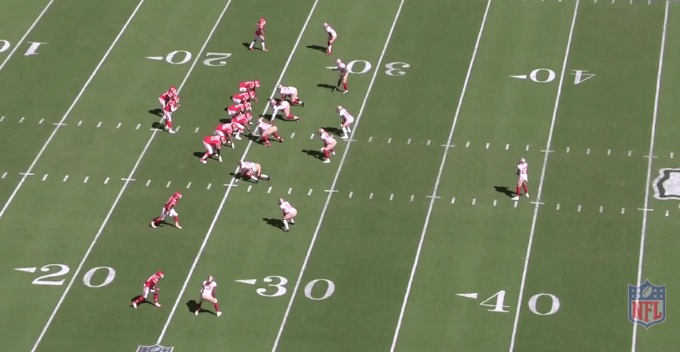
In the play above, the 49ers are playing Cover 3. This means that they have 4 underneath zone defenders and 3 deep defenders. To the bottom of the screen, The Chiefs align Travis Kelce in the slot. Kelce will run a sail route, as seen below. Reid calls a flood concept, which means there are 3 receivers running a deep, intermediate, and short route to one side of the field. Reid puts the curl flat defender in a bind, the linebacker playing over Kelce. The linebacker doesn’t carry Kelce on his route, leaving him wide open.

2018 Week 3 49ers @ Chiefs. Quarter 2 11:52

The 49ers won’t stay in Cover 3 the entire game, because Reid and Mahomes will shred them. A coverage they will run off of Cover 3 is Cover 3 buzz. This coverage is similar to Cover 3 because defenders will occupy the same areas. Instead, the defense will rotate a safety down to be a hook defender instead of a linebacker, who will then play the curl flat area. Reid dialed up double slants to attack Cover 3 buzz, which the 49ers are playing in the clip below. Mahomes throws the slant to the inside receiver at the bottom of the screen before the safety buzzing down can make a play.

2018 Week 3 49ers @ Chiefs. Quarter 1 11:58

The Chiefs will often line up in a 3×1 formation, putting 3 receivers to one side of the field. The Chiefs will line up their fastest receiver, Tyreek Hill as the 3rd receiver, the most inside receiver. They do this because in the 49ers zone scheme, a linebacker will have to cover him. Here, the 49ers pay so much attention to Hill running downfield, that Reid dials up a screen to the running back for a big play.

2018 Week 3 49ers @ Chiefs. Quarter 1 10:32

Another relevant game would be against the Chargers, who run the same Cover 3 defense as the 49ers. Here, the Chargers are playing Cover 6. This means that they are playing Cover 4 to the top of the screen, and Cover 2 to the bottom. Cover 6 is another coverage that the 49ers have played more of recently, and may call against the Chiefs on sunday. Here, Kelce runs a corner route, which should be bracketed by the corner and the safety. Instead, the corner playing low, plays his zone too soft and does not get his hands on Kelce. Kelce is wide open, because the safety is late to get over. The safety was concerned with the #3 receiver running vertical, just like the previous clip in the 49ers game from 2018.

2019 Chiefs @ Chargers Week 11 Quarter 3 5:01

Overall, the Chiefs have a lot of talent to cover. The 49ers should mix up their coverages in order to keep the Chiefs off balance. They will need their pass rush to get home if they have any chance of stopping the high powered Chiefs’ offense.

Design a site like this with WordPress.com
Get started