Featured

2019 Chiefs Pass Game Study

The Super Bowl champion Chiefs were a video game offense in 2019. They had the best QB in the NFL in Patrick Mahomes. They had the 2 fastest receivers in the NFL, Mecole Hardman and Tyreek Hill. Also, they had the league’s best pass catching tight end in Travis Kelce.

Their embarrassment of riches on offense led to a lot of points being scored. Andy Reid is a master at manipulating defenses with motion and vertical pass designs. A west coast mind, Reid continues to evolve to tailor his offense to his personnel.

Reid is famous for taking plays from the college game and even high school. As NFL offenses become more and more like college, it is not a bad idea to incorporate air raid and spread concepts from college teams, especially when they fir who you are.

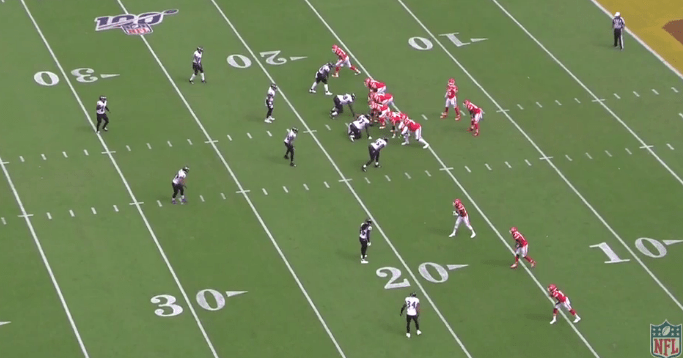
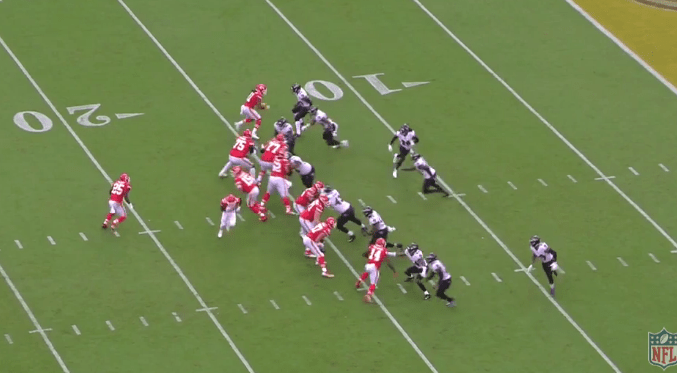
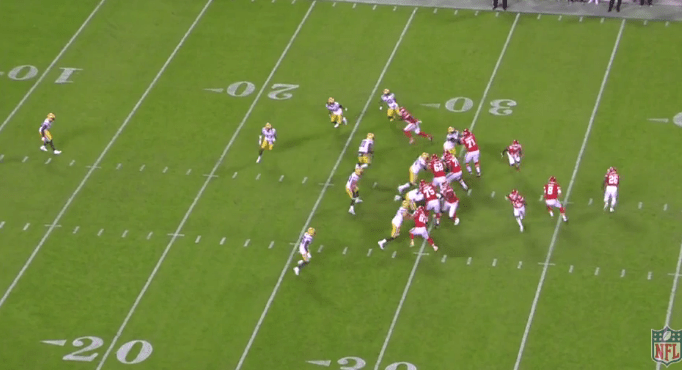
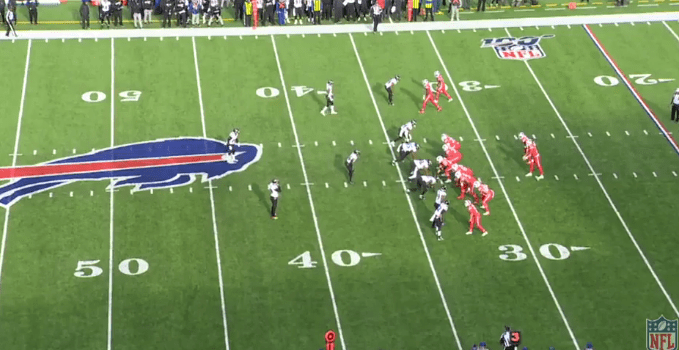
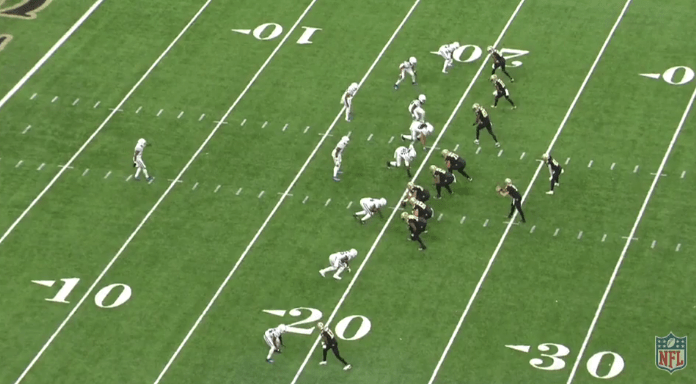
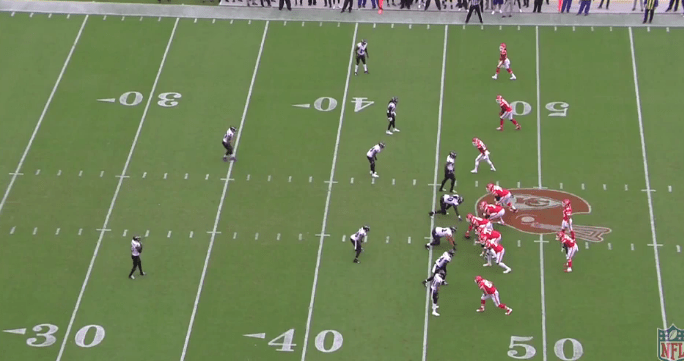
In week 3 against the Baltimore Ravens, Reid manipulated their 3 deep coverage with short motion from Sammy Watkins. Below is the initial formation.

Screen Shot 2020-04-09 at 1.27.14 PM.png

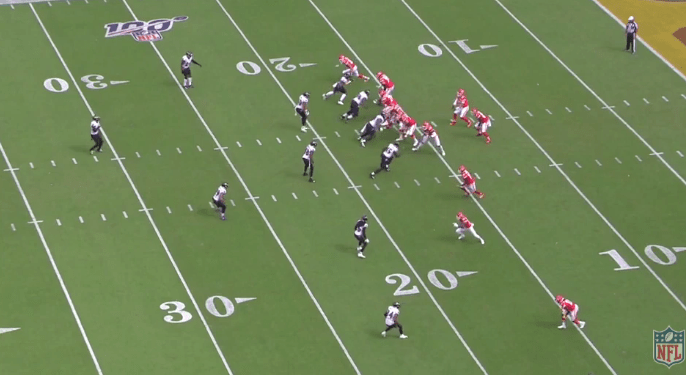
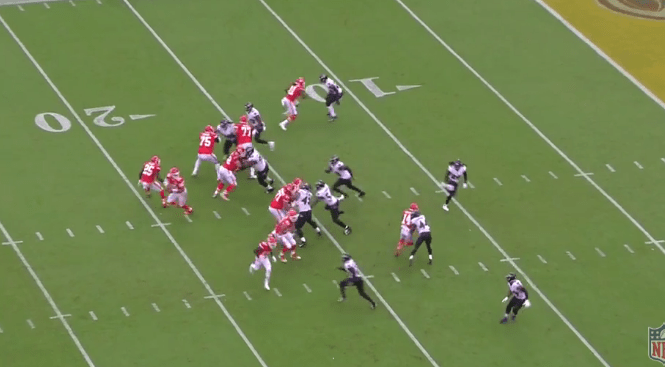
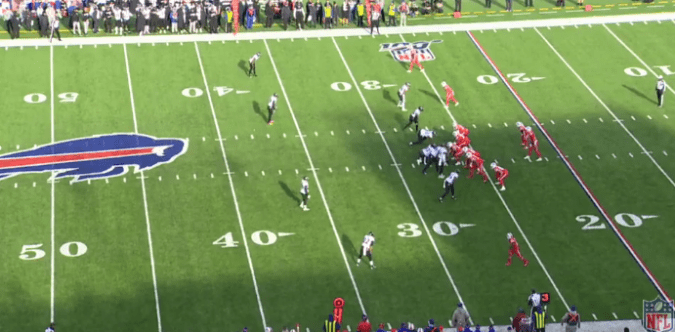
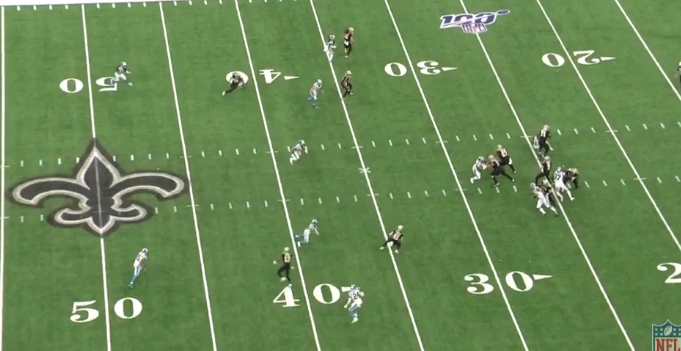
Watkins motions in, forcing the nickel and safety to the bottom of the screen to adjust.

Screen Shot 2020-04-09 at 1.27.27 PM.png

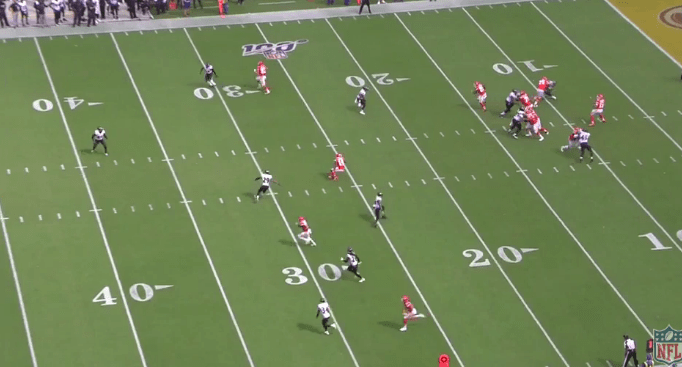
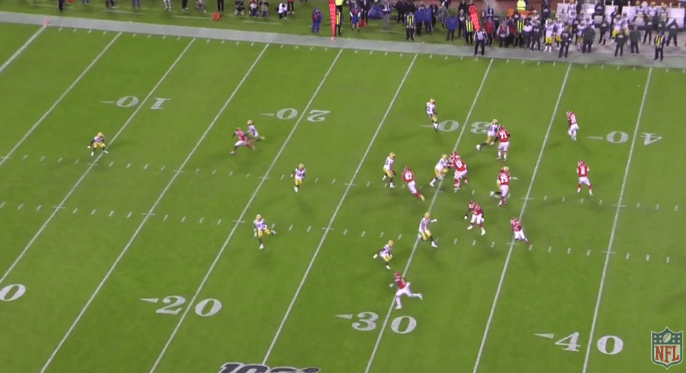
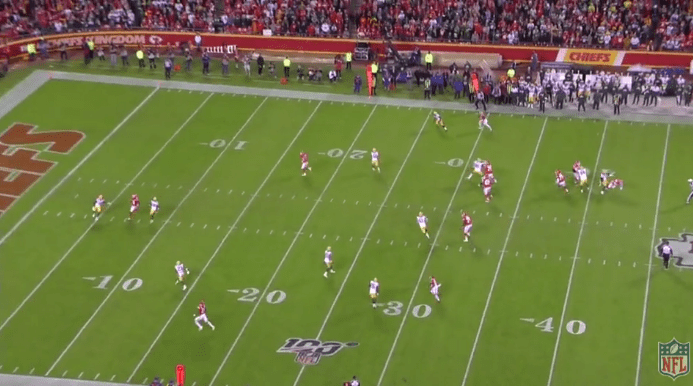
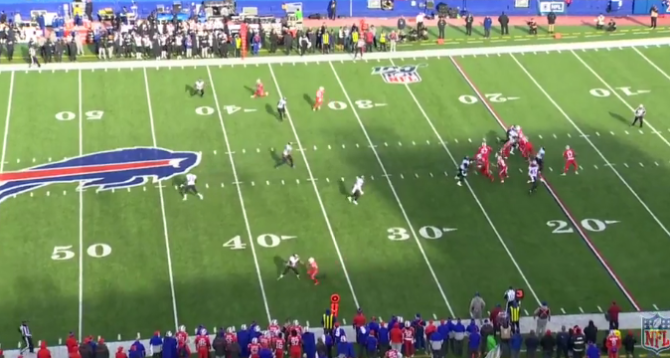
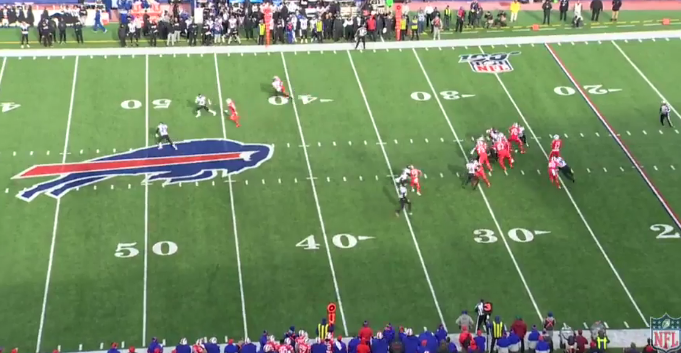
The Ravens play a 3 buzz coverage. The safety to the bottom of the screen jumps the sit route by Watkins, who motioned in. That leaves speedster Hardman running free down the seam. Even the corner, playing a deep 1/3, cannot play the seam because Hardman is too fast. Mahomes holds the deep safety so he cannot help on Hardman.

Screen Shot 2020-04-09 at 1.27.48 PM.png

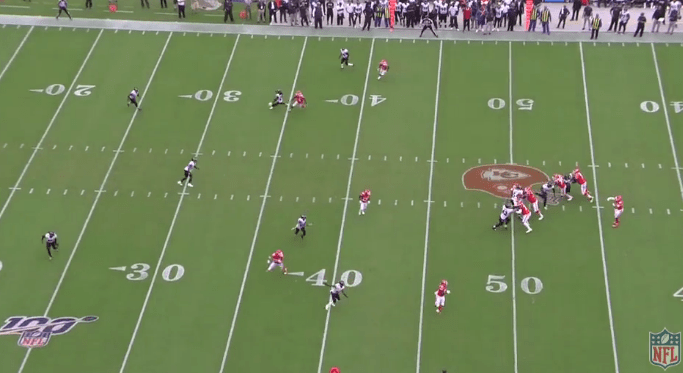
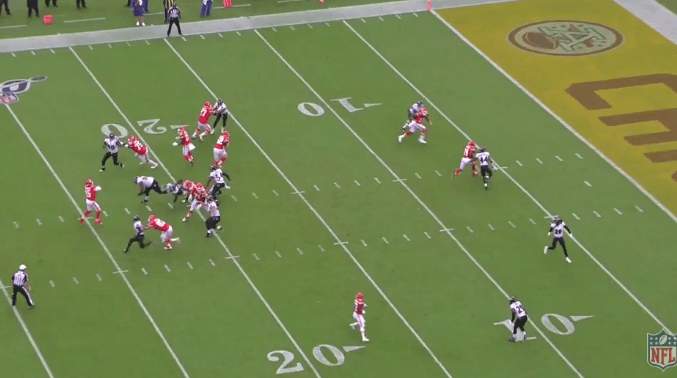
Later in this hame on 3rd down, the Chiefs align in a staple formation, 3×1 with Kelce as the single receiver.

Screen Shot 2020-04-09 at 1.38.15 PM.png

The Ravens have their dime LB, Anthony Levine, aligned head up on Kelce, indicating he will cover him man to man.

Instead, the Ravens rotate to a Tampa 2 coverage. Reid manipulates Levine with a simple hi-lo concept.

Screen Shot 2020-04-09 at 1.39.34 PM.png

Levine bites on the running back to the flat, because he knows he has a safety over the top. The safety is too deep to help, and Kelce makes the catch for a 3rd down conversion.

On a 2nd and 9 from the red zone, Reid uses motion by Hardman to get the Ravens again. Hardman is in ZZ motion, where he will go from one side back to his original side.

Screen Shot 2020-04-09 at 1.44.15 PM.png

The defense is in man to man coverage. Reid rolls out Mahomes forcing the nickel to run with Hardman on the motion. Reid makes this look like Mahomes is going to roll out and hit Hardman in the flat.

Screen Shot 2020-04-09 at 1.42.35 PM.png

Instead, Mahomes will turn back and throw a screen to the running back, LeSean McCoy. McCoy sells like he will protect the backside, as he would in a turnback protection. The result is a TD, and the defense was gassed.

Screen Shot 2020-04-09 at 1.42.42 PM.png

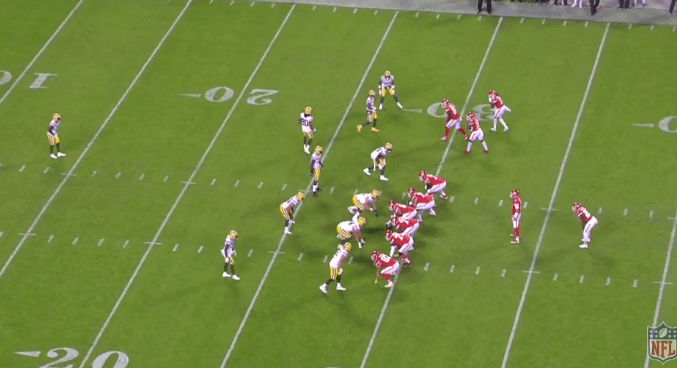
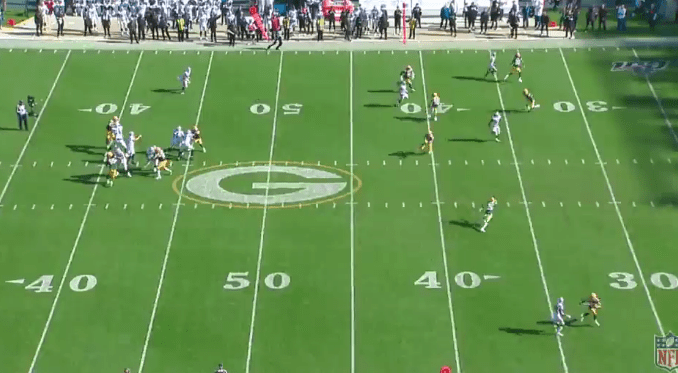
The next play comes from Week 8 vs the Packers. Mahomes did not play in this game, but Reid once again worked his magic. the Chiefs initially align in a 3×1 formation, with a nub TE, Kelce.

Screen Shot 2020-04-09 at 1.51.09 PM.png

Reid uses jet motion and they brings Tyreek Hill across the formation after the snap.

Screen Shot 2020-04-09 at 1.48.37 PM.pngScreen Shot 2020-04-09 at 1.48.45 PM.png

The post by the only receiver left to the top of the screen occupies the corner and post safety. Veteran backup QB Matt Moore buys enough time to throw the ball back to Kelce, who is left uncovered.

Screen Shot 2020-04-09 at 1.49.04 PM.png

Kelce released underneath, and the linebackers had no idea what was going on with all of the chaos in the backfield. Kelce runs underneath and then turns upfield. The Packers were in man coverage, but the corner who initially had Kelce got held up by the motion coming to his side.

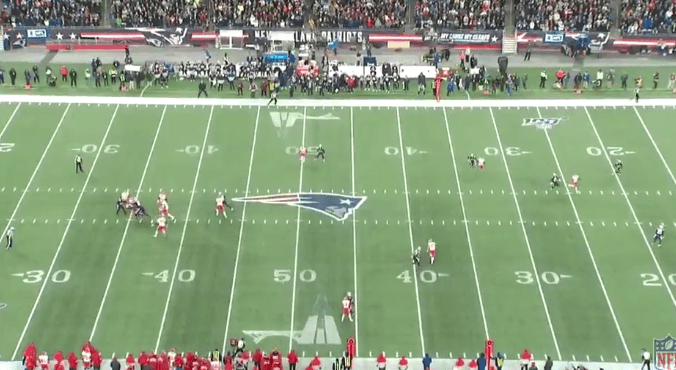
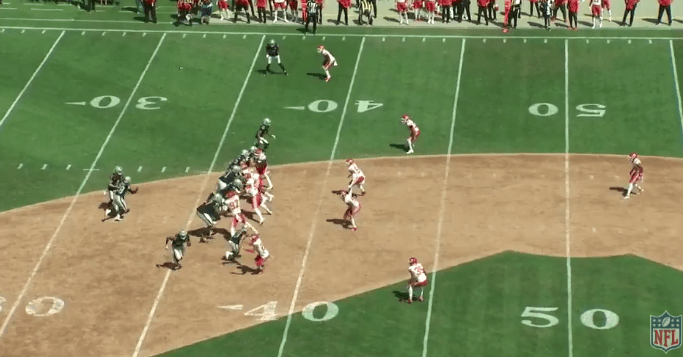
In week 14, Mahomes and the chiefs went to Foxborough and easily defeated the Patriots. The Patriots were a tough out, especially with how flatbed their secondary is.

The Patriots were forced to play 2 man, because the Chiefs have 2 speedsters. This coverage allows corners to trail receivers, jumping anything underneath with helming over the top.

The weakness of 2 man is the middle of the field. Reid sends Hill, aligned at the top of the screen on a deep dig route. Reid knows Hill will outrun the corner and make the catch.

Screen Shot 2020-04-09 at 2.08.16 PM.png

Mahomes does a good job buying time to throw it. he throws it low and away from the defender, so Hill can go down and get it.

Reid is a master at design plays to beat specific coverages. Even the best defenses give up big plays against the Chiefs because of how good their QB and skill players are. Lastly, it helps to have Reid, who is elite at designing and calling plays.


Featured

2019 Ravens Defensive Scheme: Pure Aggression

Keeping up with defense, I decided that I have to take a look at the Ravens scheme from last year. While Lamar Jackson and the offense got most of the credit, Defensive coordinator Don “Wink” Martindale was outstanding last year. Listening to NFL broadcasts, have you ever heard an announcer compliment a defensive coordinator for his play-calling? That answer is no, but that should not undermine the importance of play calling on the defensive side of the ball.

The last few posts have been more words and less film, so I’m going to get back to more film in this post. Here is a great example of Martindale’s play calling in 2019 against the Rams in week 12.

Martindale knew that he’d be able to shut down the Rams run game on 1st and 2nd down. So, the Rams plan was to move the ball on 1st and 2nd down with play action passes, because they didn’t want to face the pressure looks Martindale has on 3rd down. Martindale makes a perfect call here on 2nd and 5. He brings a double corner blitz, something you never see in the NFL. His purpose behind this call is that the running back can only pick up 1 of these blitzers, to the side of the run fake. Therefore, the other corner would have a free rush on the QB.

A lot of times, when watching the Patriots defense, I will say that Belichick will tell his opponent what he thinks of their offense by the way he plays against them. Well, when the Ravens faced the Bills in Week 13, I found myself saying the same thing about Martindale and his defense. He constantly blitzed QB Josh Allen, who is known for his inaccuracy and erratic play. Martindale never backs down, and constantly kept the Bills and Allen guessing.

On the first drive of the game, with the Bills facing a 3rd and long, Martindale dials up a 3 deep 3 under pressure. While that is a pretty standard zone blitz, Martindale shows Allen middle field open by having his safeties hold their position until after the snap.

Screen Shot 2020-04-03 at 3.10.18 PM

Screen Shot 2020-04-03 at 3.10.29 PM

Later in the game, Martindale fools Allen again. Allen wants to go to the top of the screen, to the 2 stacked receivers. The Ravens look like they are playing Cover 1, with one of the safeties expected to drop down as a robber.

Screen Shot 2020-04-03 at 3.11.43 PM

Instead, the Ravens play 3 over 2, and bracket Allen’s best receiver, John Brown. This forces Allen to hold the ball. Furthermore, the Ravens get their best pass rusher, Matt Judon, 1 on 1 vs a tight end. Judon easily bends the edge, gets flat and sacks Allen, forcing a fumble which the Ravens recovered. Allen is forced to hold the ball and doesn’t feel Judon’s rush. Just as Martindale drew it up.

Screen Shot 2020-04-03 at 3.11.54 PM

Screen Shot 2020-04-03 at 3.21.45 PM

As you can see from the tight angle, the Bills messed up their protection. They call a full slide to the right, which leaves the tight end to block Judon by himself. The Ravens are in a diamond front, which the o-line will usually make a 50 call and block 5 for 5. The back (#26) scanning from the Mike to any outside threat. Hard to tell if the protection call was Allen’s fault or the offensive line.

While Martindale sent a variety of pressures throughout the game, he decided to bring 3 all out Cover 0 blitzes in a row. The situation was this: Bills were down 24-17 on their final drive. Here is the cutup of the final 3 plays on defense. Martindale dials up an all out blitz on each play, leaving his secondary on an island with no help. Each pressure was slightly different, but the first 2 had safety Chuck Clark unblocked rushing Allen. This forced Allen to throw the ball away and prevented him from escaping.

Don Martindale did a tremendous job all year long. He didn’t have superior personnel in the front 7, but made the most of what he had. He did have a great secondary, led by top flight corner Marlon Humphrey. Even since Martindale took over as DC in 2018, the Ravens have invested heavily in corners, which has allowed him to feel comfortable sending all out pressure. Look for the Ravens to stock up on defensive talent in the 2020 draft, after signing stud d-lineman Calais Campbell in free agency.

Featured

Linebacker Techniques

As someone who wants to get into coaching, it is essential that I learn specific techniques of every position in football. The more I understand each position and what they have to do, the better I will be able to coach and put players in the best position to succeed.

While I have covered many different schemes and some players, I have yet to delve into the specific techniques of a particular position in football. Today, I will start a 3 part series on defensive techniques, with linebackers.

Linebacker is a very tough and complex position to play. They have to have the speed to run sideline to sideline to chase down ball carriers, as well as run with receivers down the field in coverage if asked to. They also have to be strong enough to take on offensive lineman and be able to defeat blocks or at least hold their ground. Very few linebackers in the NFL excel at all of that, but they elite ones do.

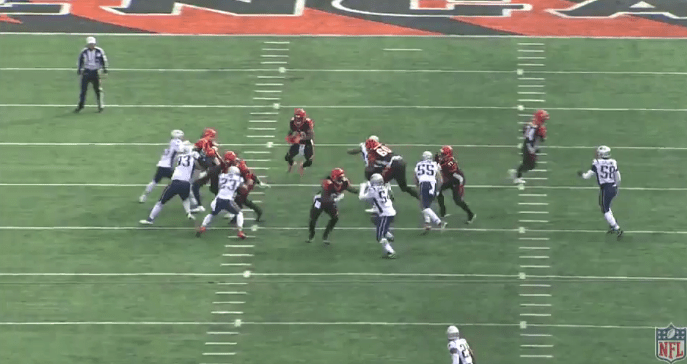
The first technique we will discuss is the dip and rip. When an offensive lineman is coming at you, you have to be able to defeat his block. The technique you use depends on the leverage of the offensive lineman in relation to you. in the first example, the linebacker will have leverage on the blocker, due to his quick recognition of the play. He is able to beat him to the spot. When the linebacker has leverage, he will dip and rip.

Here, #58 Jamie Collins uses the dip and rip technique to shed the block and make the tackle on the running back. The bengals are running inner zone, with the tight end inserting into the A gap, trying to block Collins. Collins does a great job using his leverage to dip and rip, shedding the block from the tight end to make the tackle for a short gain.

The next example is when a linebacker is out leveraged by the blocker. in this case, he will use a knife technique or a fake dip and rip. The linebacker will step behind the blocker, because he is out leveraged. This will allow him to shed the block and get to the ball carrier. 

In the same game above, star linebacker for the Patriots Donta Hightower does a great job using the fake dip and rip to escape the block from the center. He steps behind him and is able to help tackle the running back. 

Finally, there is a technique called fill and fold. This technique is used between two linebackers. It is particularly effective against teams that run the wide zone. If the offense is running wide zone right, the center will most likely look to reach the play side linebacker. instead of trying to take on the center’s block, the play side linebacker will fold backside, with the backside linebacker filling that gap hard. The center will be forced to turn back on the backside linebacker. This will force the running back to cutback, where the play side linebacker will be there to tackle. 

In this example, the center gets off the ball quickly, and is able to maintain leverage on the backside linebacker, #52. still, the play side linebacker #40, folds into the backside A gap. Unfortunately for the defense, the ball does not cut back because the center is able to effectively reach #52. 

The linebacker position is complicated, but these techniques are crucial to playing the position. As you see in the examples, linebackers must be quick to be able to read and react, then shed the block. 


Featured

2019 Dolphins: 3rd Down Pressure

The 2019 Miami Dolphins were written off before the season started. just before the season, they traded away starting LT Laremy Tunsil. Then, they traded away former 1st round pick and versatile defensive back Minkah Fitzpatrick during the season. The slogan “Tank for Tua” was thrown around by media and fans. Something that fans and media don’t understand is that there is no such thing as tanking in the NFL. Coaches and players work too hard and too long to ever go into a game wanting to lose. Besides, even on a losing team, players and coaches are working extra harder to prove to the other 31 teams that they belong in the NFL.

Miami wound up with a record of 5-11, including victories over the Eagles and Patriots, two division winning teams. What is even more impressive about that record is that the Dolphins started the season 0-7. They went 5-4 over the last 9 games, showing improvement. One thing the Dolphins never did, even when they were winless, was quit. That is a testament to the culture coach Brian Flores is creating down in south beach. Rome wasn’t built in a day and neither was any football team. It takes a lot of effort and trust to get to where they want to be, and the fact that the players are sticking together during the hard times speaks volumes.

On defense, the Dolphins ranked 30th in total defense. while that number is towards the bottom, they had a very young team, especially on defense. They also suffered key injuries, including to their best player, cornerback Xavien Howard.

The Dolphins defense is similar to the Patriots style defense. They will play a variety of fronts, based on their opponent. They play a lot of man coverage, especially on third downs. While the dolphins were starting young inexperienced corners basically all season, they did not shy away from being aggressive.

Starting in 2018, the Patriots shifted their style on defense, particularly on third down. They started blitzing a lot more, even sending true cover 0 pressures. Brian Flores was the defensive play caller and linebacker coach during 2018 for the Patriots, and he brought that package with him to Miami. They like to use the amoeba front, where defenders move around in order to create chaos. This puts stress on the offenses because they don’t know who to point mike or where to slide to.

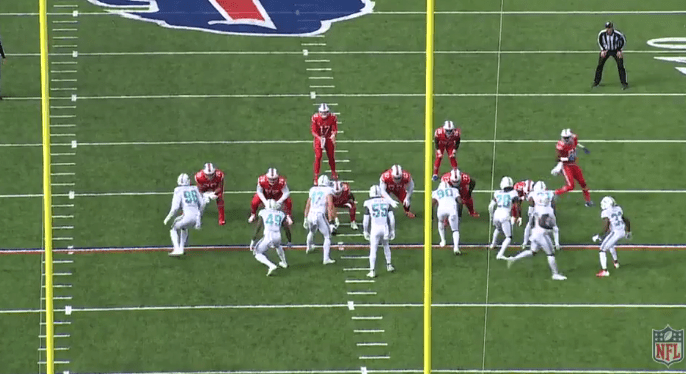
Here is an example, in week 7 against the Bills. The Dolphins are walking around before the snap. The Bills motion a receiver to confirm that it is man coverage.

2019 Dolphins @ Bills Week 7 © NFL GamePass

The Bills slide the center to the left. Allowing LB Jerome Baker (#55) to come screaming up the middle unblocked. The Dolphins also loop #49 to the outside, just in case Allen is able to escape Baker and roll out to his right, where he has 2 receivers running routes. Surprisingly, the Bills send both tight ends and the running back out on routes. The Bills did this because they knew that if they sent them out on routes rather than have them protect, the dolphins would have to cover them. But since the Dolphins are in cover 0, they can rush 6 and buffalo only have 5 to block.

2019 Dolphins @ Bills Week 7 © NFL GamePass

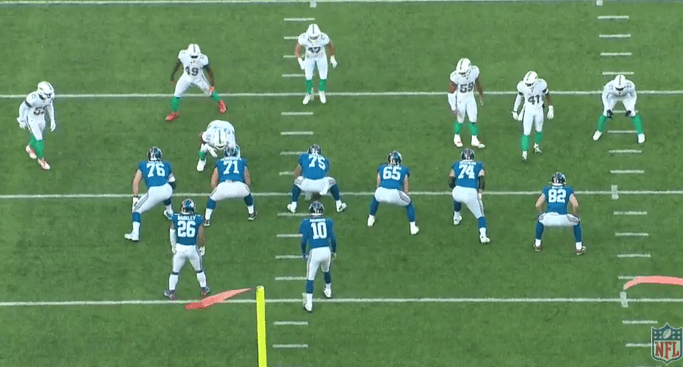
Later in the year in week 15 against the Giants, the Dolphins once again were able to get a free rusher with the amoeba front. This time, the dolphins have no down lineman, as opposed to one in the previous example.

Dolphins @ Giants Week 15 © NFL GamePass

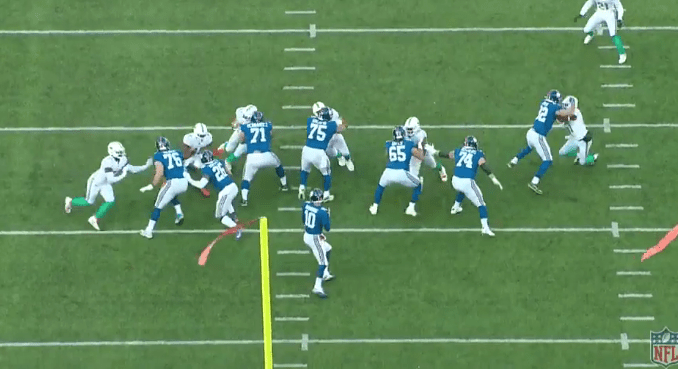
The Dolphins rush all 3 linebackers to the left of the center. Baker comes free on the rush because the left tackle makes a mistake. He originally sets to block 55, but panics and lets him go to help the running back block #49.

Dolphins @ Giants Week 15 © NFL GamePass

In the image above, look how the left tackle has his eyes inside. He takes is eyes off #55 for a split second, allowing him to come free and get a hit on the quarterback. As you can see, the Right tackle has nobody to block, but the dolphins are able to get #55 a free rush to the quarterback. Granted, if the LT had stayed on his man, Baker would be picked up. Again, the amoeba front is used to cause confusion, which it accomplishes in both examples.

Featured

Patriots Empty Pass Game

The New England Patriots have won 6 Super Bowls under Bill Belichick and Tom Brady. There are many reasons why they’ve been successful, but one of them is keeping things simple for their players so they can play fast and execute at a high level. One of the things they do offensively is spread teams out with empty formations. The beauty of this is the patriots will do this when they have 21 or 12 personnel on the field. This means that the defense will have their base defense, or in other words, their bigger players on the field to try and stop the run. That is because when the Patriots have two backs or two tight ends on the field, the opposing defense is thinking they are going to run the ball.

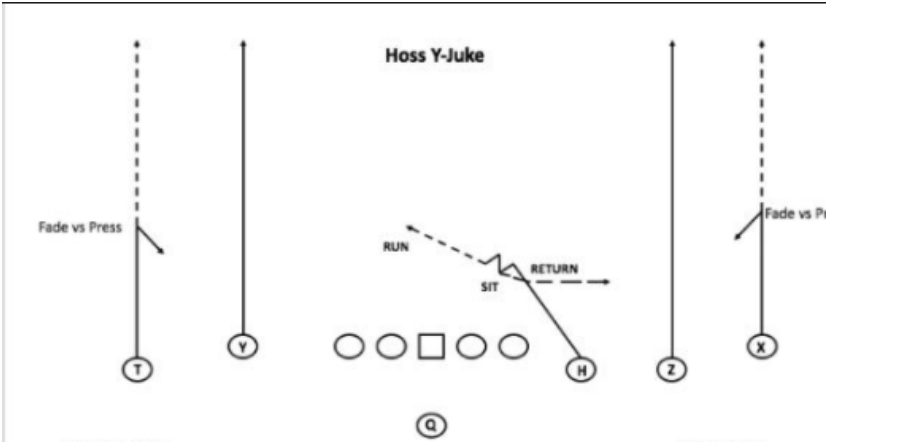
One of their favorite empty concepts is called hoss y juke. The hoss is a condensed word that means hitch by the #1 receiver and a seam rote by the #2 receiver. The Y, usually the TE, has a juke route which can actually be 3 different routes depending on the leverage of the defender they are running off of. Here is a diagram of the play.

© Riley Kolste Football

As you can see, the #3 receiver, called the H in this diagram, will run his route based on the defender, usually the mike linebacker. In general, he will sit if it is zone or run if it is man. To take it a step further, if the defense is playing zone coverage and the Mike is walling him inside, he will return back out. The outside receiver on both sides also have a rule. If the defender presses him, he will run a fade. If he plays off and gives them cushion, he will run a stop route at about 5 yards.

The Patriots will sometimes run this play multiple times a game. The play has answers against essentially every coverage. The Patriots also can go hurry up in a run formation with Brady under center, and then hurry to the line and spread them out in empty. Usually, the patriots will put their best receiver, Edelman, at the #3 because it will get him matched up on a Mike linebacker. They put their fullback or running back out wide. There are two reasons for doing this. One, if a linebacker goes out to cover the running back out wide at #1, the patriots know the defense is in man coverage. if they have a corner out there, it means the defense is in zone coverage. Linebackers that only play in the box are uncomfortable going out wide and playing where corners normally play.

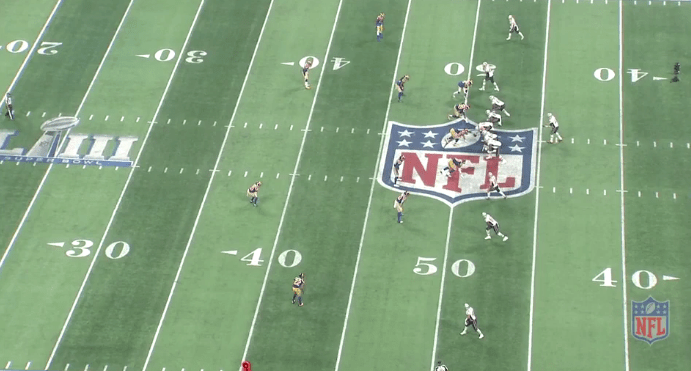
There are many examples of this play since the Patriots have run this play for decades, but the best example is from the Super Bowl last year against the Rams. With the game tied at 3-3 and neither team could do anything offensively, the patriots reverted to hoss y juke.

Super Bowl LIII © NFL GamePass

The Rams play a quarters coverage. The Patriots actually use 22 personnel, aligning their fullback and running back on the outside. Edelman will run his route off the mike linebacker, who has inside leverage at the snap. Edelman will return out, because of the defender’s leverage. Easy gain of 13 and a first down.

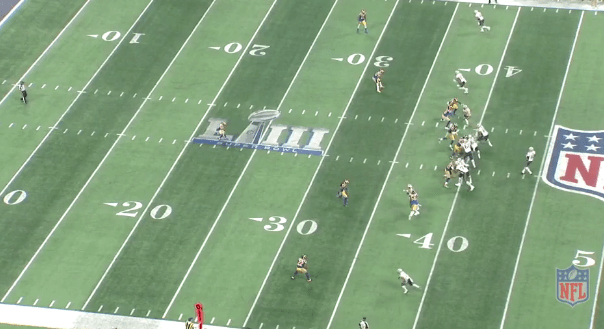
The next play, the Rams play a single high coverage. They know the Patriots are going to exploit the matchup again with Edelman on a linebacker. So they decide to double both Edelman and TE Rob Gronkowski in the slot to the bottom of the screen.

Super Bowl LIII © NFL GamePass

Against a single high defense, Brady will go to the hitch/seam combo. He sees the corner #22, at the bottom of the screen, play off with his eyes inside. With the corner playing off, Brady throws it out to the running back Burkhead for a gain of 7 yards.

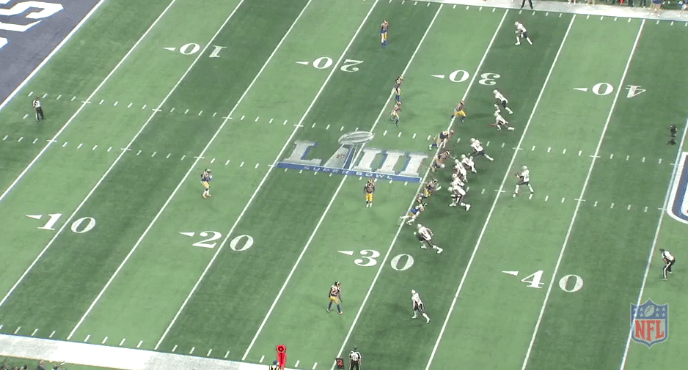
On the third play, the Rams are late to get lined up, but again play a single high coverage. Brady does a great job holding the free safety in the middle of the field, by looking to his right, away from Gronkowski, in the left slot. The Safety is unable to influence the throw, and Brady throws a perfect touch pass, laying the ball out where only Gronk can get it. since the linebacker was late getting over, he was behind Gronk by a step, just enough space for the pass to be completed.

Super Bowl LIII © NFL GamePass

This series of 3 plays single handedly won the Super Bowl for the Patriots. Hoss Y Juke is a play the Patriots use for so many years because the players can execute it and it gives them an answer vs any defense. While many would say, “why can’t they stop it if they run the same play for years,” the patriots run the play out of different personnel groupings and move guys around. When used with tempo, the play becomes even more dangerous. The Patriots always seem to find advantages other teams can’t and this is just another example of their brilliance.

2019 Saints Pass Game Study

Sean Payton and Drew Brees have a great relationship, that stems from their long time  together as well as their desire to win. Payton masterfully designs the Saints offense each year to tailor it exactly to the personnel he has.

In 2019, the Saints added TE Jared Cook, a mismatch nightmare. Cook is outstanding at using his big frame and large catch radius. His strengths are running vertical routes, such as seams and sail routes, from the slot or in-line.

A lot of teams have great weapons, but few use their weapon better than Payton uses Michael Thomas. Arguably the best route runner in the game, Thomas is so physical and adept at understanding coverages and defender’s leverage. Payton features Thomas on crossing patterns, dig and out routes, now slants, and maybe most of all, option routes from the slot.

During his own quarantine, Payton shared a popular Saints concept, in which Thomas runs an option route from the slot. The concept is called “Shock Lucy.” Shock is a 3 man route concept, shown below. The “Lucy” is the option route, which many west coast offenses call “Lookie.”

An example from 2019 of this play, where Thomas runs the Lucy. The Bucs play Quarter coverage, so Thomas will run his route off the Will linebacker. Because the coverage is quarters, the Will LB has inside leverage. Thomas sees the Corner backed off at quarters depth, so he knows he will be able to win outside. He shakes the LB inside, before exploding outside. Kamara runs off the Corner, giving Thomas a ton of room to operate after the catch.

The Saints will also run the Shock Lucy concept with Cook running the Lucy instead of Thomas. Occasionally, Kamara will run it too.

Another staple concept in the Saints playbook is 4 verts, or All Go Special. While Payton has a few variations in his toolbox, most of them are out of 3×1 formations, with Thomas as the backside X receiver and Kamara the back aligned to the weakside.

Against the 49ers, the Saints run “52 All Go Special X Shallow Cross H Choice.” On this play, the 49ers are in a type of combo matchup zone coverage. To the top of the screen, they are basically playing man to man, with 3 defenders matching the 3 vertical routes. On the backside, they play Cover 2, with the corner letting Thomas run underneath on his shallow. Kamara will have the option to break out, in or sit down. Since the Will LB and the cloud Corner are in zone, he sits down between the 2 of them.

While the Saints have their stale concepts they run every week, Payton is notorious for adding a few unique plays every week. Against the Bucs in Week 11, Payton schemed a shot play after getting a fumble recovery on defense.

The Saints line up in a 3×1 formation, with a nub TE to the boundary. The formation gives Brees a man/zone indicator. Since the corners are over, Brees knows it is man coverage. The play was put in not only because is it a man coverage beater, but because it works against quarter coverage, which the Bucs call a lot.

The #1 and #2 receivers run inside, clearing space for Thomas to work on his slot fade. The corner covering Thomas is picked by the #2 receivers route, so Thomas is wide open. Payton schemes plays for his best players to make plays. It is no coincidence why Thomas led the NFL in catches in 2018 and 2019. By the way, his 2019 stats were video game numbers; 149 catches 1725 yards and 9 TDs.

Some other quick hits about the Saints pass game. The Saints run double stick out of 2×2 formations on early downs. This is a quick game concept to get the ball out of Drew’s hands and gain some easy yardage. Payton also likes drive concepts, with Thomas or Cook running the dig. Two frequent 3 man concepts are snag and spot-dig, primarily out of bunch formations.

Here is double stick out of 2×2 against the Colts. Brees throws to Cook in the slot at the top of the screen, working on a linebacker.

Screen Shot 2020-04-06 at 7.39.13 PM

Here is snag-dig out of bunch. Thomas runs a speed dig and and Kamara a choice route backside.

Screen Shot 2020-04-06 at 7.35.51 PM

Payton is so good at using formations to his advantage. He will spread teams out by going empty out of 21 personnel. He will stick Thomas and Cook, his 2 best weapons, inside and put a fullback or tight end out wide. Again, a man/zone indicator for Brees and an easy way to get Thomas matched on a linebacker like he does with the Shock Lucy play.

As Brees gets older, he becomes more and more of a point guard. He is a ball distributor, who beats teams with his mind. Granted, his subtle movement in the pocket to compensate for his lack of height, as well as his accuracy are still elite. Brees’ skillset and Payton’s creativity are a perfect marriage that will continue for at least 1 more year.

Jon Gruden’s Raiders 2019 Offense Study

After a successful run as a head coach and offensive play caller that ended in 2008, Jon Gruden became a popular figure as a broadcaster for ESPN. In 2018, he came back into coaching and returned to the Oakland Raiders, where his head coaching career started. His hiring was highly controversial, partly because he was awarded a 10 year 100 million dollar contract and partly because many around the game thought that the NFL has passed him by.

While 2018 was a rough year for Jon and the Raiders, 2019 was a better year. They were a game short of a wildcard berth, and QB Derek Carr yards per attempt went from 7.3 in 2018 to 7.9 in 2019. Also, Carr’s completion percentage was never above 63.8 before Gruden came back to Oakland. Since, Carr has posted impressive completion percentages of 68.9 in 2018 and 70.4 last year.

Gruden is famous for the west coast offense. It features a timing and rhythm pass game. Many were skeptical that he would keep the QB under center and make him execute 5 and 7 step drops. Well, that is not the case. Gruden has adapted his offense to the current NFL, featuring RPO’s and quick game concepts out of tight and condensed splits. That is why Carr’s completion percentage is so high.

In 2019, Gruden paid big fast wideout Tyrell Williams to be his X receiver. He also found gem TE Darren Waller who is 6’6 and 255 lbs but runs 4.5. He is a unicorn that is a matchup nightmare wherever he lines up. They drafted Josh Jacobs, a true bell cow back, that can run with power and has great vision.

Gruden does a great job fitting his scheme to his QB and his players. A concept Gruden likes to run often is stick. Here is a basic stick RPO. The quick run fake holds the mike linebacker.

2019 Chiefs @ Raiders ©NFL GamePass

Gruden has the tight end run to the flat, which holds the curl flat defender. That leaves a void for slot receiver Hunter Renfrow to sit down and catch a stick route. This RPO putsch Mike in conflict and makes him late to cover the stick route, which results in an easy completion.

2019 Chiefs @ Raiders ©NFL GamePass

Gruden did a great job throughout 2019 scheming plays for his players. Here is a great one for Waller. Oakland aligns in a weak I pistol formation. The Packers are playing split safety coverage. Due to the formation, the safeties play closer to the LOS.

Gruden runs a variation of 4 verticals. He uses the back offset to the left on a seam, route. The safety to that side is in a bind, leaving the middle of the field wide open for Waller on a hash route.

Gruden loves using tight splits on 3rd downs. Tight splits give receivers more room to work. On third down most defense will play press Cover 1. By using tight splits, Gruden forces defensive backs to back off in coverage, allowing his receivers free releases off the line.

Renfrow runs a quick slant by setting up the corner outside, before breaking to the inside. The corner is playing off man, due to the tight split. Renfrow possesses short area quickness, which Gruden features on plays like this. 

Gruden aligns Williams as the #3 receiver on third down. Williams runs a deep crossing route against man coverage. Williams uses his big body to box out the corner and get in front of him to make the catch. Again, another example of Gruden scheming up plays that highlights his receivers’ strengths. 

In the ground game, Gruden uses a diverse ground game. he mostly runs the wide zone, but mixes in duo and some other gap scheme runs. Jacobs is a versatile back that can run between the tackles but also has the speed to get to the edge on outsize zone and crack toss plays. 

Against the Texans, Jacobs has a great feel for defensive fronts. When the tight end motions across and the linebacker comes with him, it is an indicator that the defense is in man coverage. Jacobs sees #41 reading him, so Jacobs takes a step inside, before taking the ball out to the edge. That allows #83 to seal him, and Jacobs is able to break a big gain outside. 

Tremendous job here by Jacobs to set up his blocks and understand what the defense is doing. Jacobs also flashes his speed to turn the corner and create big gains in the ground gme. With the multiple all-pros that Oakland has on their o-line, Jacobs is able to execute any run scheme. 

Gruden’s offense operated at a pretty high level in 2019, considering the injuries they sustained. They finished 11th in yards. Gruden did a lot to scheme up plays for his best weapons; Waller, Williams and Renfrow. If this offense is able to add a big time receiver, this offense can take off in 2020. 

Defensive Back Technique

Defensive back is a tough position to play because you have to match up against the best athletes on the field. If you are in zone coverage, you have to be able to read routes in less than 3 seconds, which is about the average time it takes a quarterback to release the ball. If you are in man, you have to be able to cover the receiver, no matter what technique you are playing. There are so many different possible coverages a DB can be in, but there a lot fewer techniques.

First, let’s talk about corners. When it comes to man coverage, a corner will play a few techniques. The most popular technique is press. In this alignment, the corner will  jam the receiver with the hand opposite of the receiver’s release, often referred to as the off hand. If the corner jams with the same hand, he will lose his leverage. Leverage is something that the corner and receiver must understand. Every snap, the receiver has a plan to attack the corner, and the first thing a receiver will do is look at the corner’s leverage and depth.

If the coverage is 2 man, the corner will play with inside leverage. He will have help deep down the sideline from the deep safety to his side. Also, in 2 man, the corner will play a trail technique. The corner will let the receiver get behind him and stay in his hip pocket  to undercut any route he runs. In Cover 1, the corner will play with outside leverage, because his help is inside, from a post safety. Sometimes, he will also have inside help from a robber or low hole player.

A popular technique is called inch technique. The corner will stay square to the receiver, giving ground. He is doing this to be able to cut off the receiver which ever way he goes.  In the second tweet, Detroit Lions head coach Matt Patricia talks about how he teaches inch technique when he was the defensive coordinator of the Patriots.

A lot of coaches like to use the boards to prevent corners from crossing over their feet. Some coaches will have corners do drills with their hands behind their back when drilling mirror technique.

There is also mirror technique. This technique is exactly how it sounds. The corner will mirrors the receivers moves, never crossing over his feet. The goal of the corner is to make the receiver release around him. This takes time, and will allow the pass rush to get there. The corner will never turn and run. He will shuffle, or quickstep as some coaches call it, opening his hips at a 45 degree angle.

Sometimes, corners will play off man, and in this case they will play catch technique. The corner will catch the receiver, usually 5 yards, due to the no contact rule beyond 5 yards in the NFL. This coverage will be used in long yardage or in the red zone. Catch technique disrupts the timing of routes.

In zone coverage, safeties and corners will backpedal and break on the football, when playing quarters coverage. Quarters is called cover 4, but really turns into man coverage after route distribution. Heavy quarters teams need athletes at safety that can cover receivers down the field. In Cover 3, both outside corners are responsible for a deep 3rd of the field. They will turn and run with their eyes on the quarterback, as well as the #2 receiver. They have their eyes on #2 because if he runs down the seam, he has to be able to play it. If #1 goes vertical too, he has to midpoint the 2 routes. In zone coverage corners will read the QB front shoulder, not his eyes.

In conclusion, a corner must communicate on the field and focus on his technique to be successful. Most importantly, corners must have a short memory. They will get beat and even the best corner in the NFL gets beat. When you keep getting beat, it is easy to lose confidence. The NFL is a matchup league, and offenses will exploit corners who are struggling.


Defensive Line Technique

Defensive line play, schematically, is probably the simplest position to understand. There aren’t many things defensive lineman have to do. As opposed to the secondary, where in some defensive systems (think Saban at Alabama) there is a check for every single offensive formation that is signaled in by the coaches. Defensive backs must be able to see the call, and react in a split second to know who their assignment is as the play unfolds. Then, of course, they have to cover that man. Still, defensive lineman must understand where to line up, what they are doing, and be able to recognize blocking schemes in real time.

The defensive line is seldom broken down on twitter, or line play as a whole for that matter. There are certain phrases that even fans know, such as the 3 technique or the fact that 1 gapping or 2 gapping exist. (For any fans reading this, a 3 technique isn’t just an interior lineman that can rush, and he doesn’t always line up as a 3 technique). Fans and twitter scouts believe that because they know these 3 terms, they are qualified to scout draft prospects and NFL free agents, and can tell you if that player is a scheme fit for their team or not. Good for them.

First, let’s tackle 1 gap vs 2 gap. Certain schemes usually ask defensive lineman to get up the field and shoot their gap, think 1 gap. Other shames ask their defensive lineman to hold their ground, letting linebackers and safeties fit and tackle the ballcarrier. This is true, but isn’t the whole story. Sometimes, defensive lineman 1 gap or 2 gap based on their alignment. If they align in an outside shade (think 1,3,5,7 technique), they will play their gap, so they’ll one gap. For example, a 3 technique, playing the outside shoulder of the guard, will play that B gap he is lined up in. On the other hand, a head up lineman, will 2 gap (think 0,2,4,6 technique).

Some schemes will have defensive lineman 1 gap to one side and 2 gap to the other. Courtesy of Coach James Light on Twitter, here is an example of a front that the Patriots use to stop the run. Both ends, in tight 5 techniques, will play 1 gap, the C gap. The tackles, both head up, will 2 gap.

Image

Each defensive line coach might teach landmarks differently for defeating blocks. Also, defensive line coaches name each offensive blocking technique differently. One fairly universal term is the scoop block. This is when a center and guard will work through the shade/nose (1 tech) to get up to the linebacker.

One of the best line coaches ever, Pete Jenkins, wants his shade to keep his body on the center, to keep him from climbing. The shade will shuffle and throw his butt into the guard to keep the linebacker clean, allowing him to make the tackle. No matter who the coach is, a coach will never trade 1 for 1, only 2 for 1, which is exactly what this technique is doing. A popular term for this technique is lag technique.

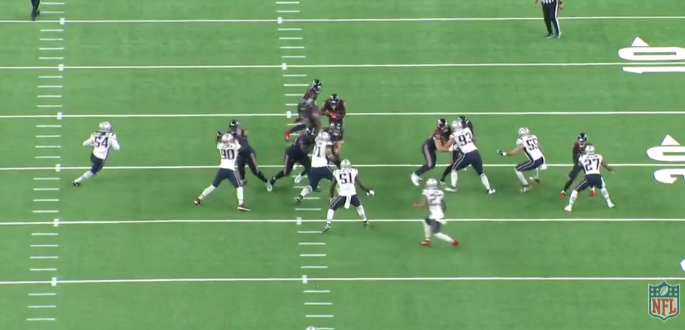
To show some film, look at #71 Danny Shelton here as the head up nose. He plays the center’s block, then feels the guard on him. He throws his hips into the guard, and trades 2 for 1.

Screen Shot 2020-03-30 at 6.44.07 PM
2019 Patriots @ Texans Week 13 ©NFL GamePass

Screen Shot 2020-03-30 at 6.44.45 PM
Enter a2019 Patriots @ Texans Week 13 ©NFL GamePass 

Defensive lineman have to play the man on them, while being able to see into the backfield to see where the ball is going. Current LSU Head Coach Ed “Geaux Tigers” Orgeron, used to coach the defensive line at LSU. When speaking at a clinic he said “Coach the eyes of your players. Watch what they are looking at. There is no way the defender can knock the blocker on his butt if he is looking in the backfield. The only way the defender can look in the backfield is to defeat the block first.”

Both Jenkins and Orgeron agree that an outside shaded lineman strikes with his inside hand to the breastplate working up to the throat. The other hand goes to the outside shoulder of the guard. If the ball is run in that B gap, that outside shade (3 tech) needs to pull down on that outside shoulder of the guard and shed the block to make the tackle.

Different coaches teach their players different keys to read. Some teach man keys and some teach their lineman to read the leg of the guard, if you are a 3 technique or 4i. If the guar’s leg comes toward you, play lag technique. If he goes away, work down the line of scrimmage, shoulders square to the line of scrimmage.

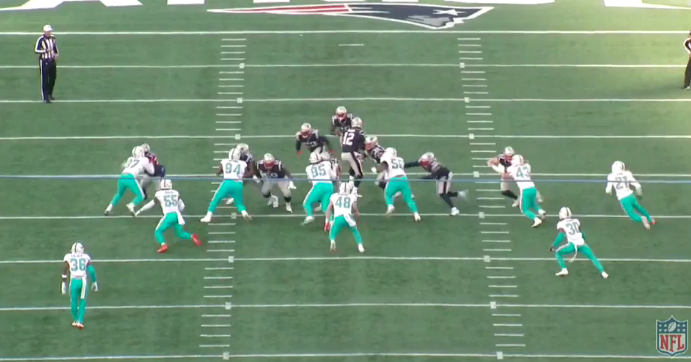
A textbook example comes from #56 Davon Godchaux of the Miami Dolphins. He’s lined up in a 3, and the guard goes away. He chases the hip of the guard, and blows up the play.

Screen Shot 2020-03-30 at 7.14.26 PM
2019 Dolphins @Patriots Week 17 © NFL GamePass

Real quick, I almost forgot. When it comes to stance, if you are an outside shade, your inside foot is back and inside hand is down. The opposite is also true, if you are in an inside shade, such as a 2i or 4i, your outside foot is back and outside hand is down.

Defensive line is not a mentally hard position to play, but it is physically hard. They also do the dirty work and do not get the credit or recognition they deserve, in terms of tackles and sacks.

In a nutshell, the key to playing the defensive line is using hands well, having your eyes in the right place, a strong get off, and knowing your assignment.


Can Philip Rivers still play?

Many have doubted Philip Rivers over the years for his lack of postseason success. The bottom line is that Rivers is a hall of famer. Forget about what fans think, ask any NFL coach and they will tell you that Rivers is among the games elite. He is able to decipher coverages and blitzes as good as anyone in the NFL. He is a tremendous person, leader and teammate. Ask anyone who has ever played with him.

The Colts just signed Rivers to a 1 year deal worth 25 million. After a subpar season in 2019, where the Chargers went 5-11 and Rivers threw only 23 TD passes to 2o interceptions, many doubt whether Rivers can still play at a high level. This post will answer that question.

I decided to only use 2019 games when breaking down film of Rivers, since that is most relevant to predicting his performance going forward. It must be noted how awful the chargers offensive line was in 2019. That is a problem for any quarterback, but it is a bigger problem for Rivers. That is because he has zero mobility, meaning that if any of his lineman get beat clean, he’s not able to extend the play.

The biggest allure about the Colts is that they arguably have the best offensive line in football. Quentin Nelson is the best guard in football, while LT Anthony Castonzo has been a solid player for a long time, and just resigned with the Colts for 2 more years. According to Pro Football Focus, RT Braden Smith graded out as 79.8, Center Ryan Kelly posted a grade of 73 and only allowed 1 sack in 2019. Both of those grades qualify in the above average tier. The weakest link as RG Mark Glowinski who had a 60.5 overall grade, which is considered average. Overall the colts line is really good in the run and pass game.

While the Chargers had a few blowout wins against bad teams, I decided to look past those and watch Rivers against a good defense. The Tennessee Titans are a tough defense to face, due to their pressure looks and coverage disguises. If it wasn’t for a last second fumble by Melvin Gordon, the chargers would’ve won on the road against the titans. Regardless, let’s check out some plays from the game.

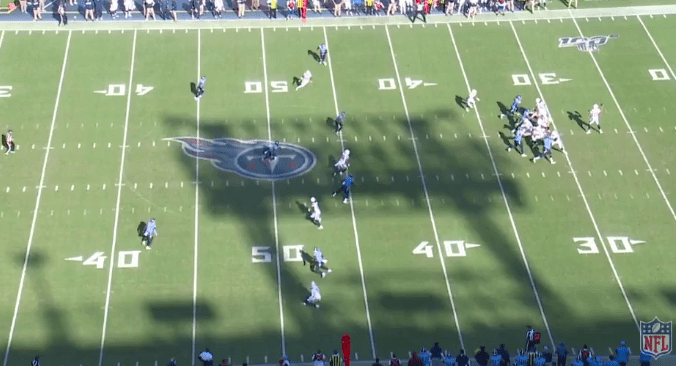
First drive of the game, Rivers showed off his best talent when it comes to throwing the football; touch passes. Rivers throws with tremendous touch, putting the ball away from defenders and drops it in places where only his receiver can get it, often leading them to an area of the field. here, on a 3rd and 8, Rivers knows its man coverage. Henry is 1 on 1 on safety Kevin Byard with the whole sideline to work with. Rivers throws the football away from Byard, and lets Herny go get it for a big 1st down conversion.

2019 Chargers @ Titans Week 7 © NFL GamePass

The second play comes on the following drive. Rivers reads the 3 receiver combo to the bottom of the screen. Rivers looks to throw the sit to Henry, but sees it is squeezed by two defenders. He quickly works back to the single receiver side, and finds his back Ekeler. Rivers is famous for using his running back as a check-down option. That is one of the reasons why Ekeler had 92 catches in 2019. Rivers’ ability to process a coverage post-snap is second to none.

2019 Chargers @ Titans Week 7 © NFL GamePass

On the third play, Rivers once again shows his incredible touch throw ability. He processes that it is Cover 3 so quickly, that he releases the ball well before Henry looks for it. Rivers knows that the corner to that side will carry the vertical route by Williams, leaving a big void deep down the right sideline. Rivers understanding of the coverage allows him to put air under the ball and let Henry go get it towards the sideline. Rivers knows that the only defender who can make a play on the ball is the curl flat defender, so Rivers gives Henry a chance to run by him on his deep corner route.

2019 Chargers @ Titans Week 7 © NFL GamePass

Here is the full play from the broadcast copy.

The final play comes on the last drive of the game. The Chargers come out in empty with Ekeler flexed out as a receiver to the top of the screen. They run a simple slant-flat combination with Ekeler running the slant. The Titans disguise their coverage until the last second, rotating to Cover 2. Rivers anticipates the window to throw the slant, getting it past the hook player, playing over the #2 receiver.

In this game alone, Rivers showed his ability to decode coverages before and after the snap, allowing him to make quick decisions. He throws with anticipation and precise timing, which are traits that only elite quarterbacks possess. He still excels at touch throws because of his Ph D level understanding of defenses. Rivers may not be able to carry a team on his back anymore, but with the offensive line and weapons around him in Indianapolis, Rivers can function as a point guard for the Colts. His arm still works and his mind is as good as it ever was. That will be more than enough to lead the Colts to the playoffs in 2020.

How to fix the Rams for 2020

Sean McVay started out with a bang when he was named the head coach of the Rams. He signed quality free agents such as Robert Woods and Andrew Whitworth. He fixed quarterback Jared Goff, who was labeled a bust after his rookie year in 2016, with a quarterback friendly system. That system also helped turn around young running back Todd Gurley who was the 4th overall pick in 2015. The Rams made the playoffs in 2017 and then made it all the was to the super bowl in 2018.

Unfortunately, the Rams took a step back in 2019, missing the playoffs altogether. The offense was inconsistent, and the defense was vanilla. So far in 2020, McVay has shaken up the coaching staff, with the hires of offensive coordinator Kevin O’Connell. O’Connell held McVay’s old job, as offensive coordinator of the Redskins. The Rams have not had an offensive coordinator since McVay’s first year in 2017, when current Packers head coach Matt LaFleur held that title. The OC is important for McCoy because it will allow him more freedom. O’Connell will help with game planning and add another voice for McVay to bounce ideas off of, during the week and on game day. McVay will still call plays on game day, but will be able to focus more on other areas of the team.

McVay hired young defensive coordinator Brandon Staley, who is a young, fresh mind that has drawn comparisons to McVay himself, in terms of his innovation and energy. Staley spent the last two years under Vic Fangio, who I wrote about in my last post. While Staley has only served as outside linebackers coach, he has 4 years of DC experience at the college level spending time at John Carroll and James Madison. His quick rise up the coaching ranks is not dissimilar to McVay. The biggest takeaway from this hire is that Staley has been groomed by Fangio and learned his defense, which is a defense that has given McVay and his offense problems. McVay’s respect for Fangio’s defense is an indicator that he wants his defense to resemble Fangio’s. What better way to do that than hire someone who worked under him the last 3 years.

Quickly, on defense, the Rams have multiple key players that are set to become free agents. With limited cap space, considering they will have to resign a few of their own, the Rams cannot afford to franchise tag anyone. Linebacker Cory Littleton, edge rusher Dante Fowler and defensive tackle Michael Brockers will hit the market. Of those 3, I believe Littleton must be retained. He is outstanding in coverage and is a leader on the defense. Fangio’s scheme, as I talked about in my last post, needs strong linebacker play. Littleton is only 26 and is coming off a year in which he posted a 90.6 coverage grade that ranks third-best in the league, according to Pro Football Focus. While he is small for a linebacker and not as stout against the run, the Fangio scheme asks their defensive lineman to occupy blockers to keep the inside linebackers clean. While it would be nice to retain Fowler and his 11.5 sacks from 2019, he will be out of the Rams price range. They should be able to sign a cost effective edge rusher, such as Jason Pierre-Paul, who had 8.5 sacks in 2019. Another pass rusher, Markus Golden had 10.5 sacks on a bad Giants defense. Both played outside linebacker last year and will cost in the 7-10 million a year range, as opposed to the 15-18 million range that Fowler will receive on the open market.

On offense, there are many questions. Goff and Gurley regressed in 2019. So did Brandin Cooks, who the Rams gave up a 1st rounder for in 2018. The offensive line needs help. The only consistent lineman last year was Whitworth, who is a free agent and 38 years old. If Goff is going to play better, they are going to need Gurley to play better and Gurley is gonna need more help from the offensive line to open up run lanes for him. This domino effect will not be easy to solve, especially with limited resources. So here is how I would solve it, if I were Sean McVay.

First, McVay must re-sign Whitworth. I know most people will balk at his age, but Whitworth found a second life with the Rams when he signed there in 2017. He still played very well last year, and great tackles are playing into their late 30’s now, see Jason Peters. Whitworth is a technician at LT, switching up his pass sets to keep opposing rushers off balance. He is outstanding at cutting off the backside, and also at taking care of the play side edge defender, when the Rams run wide zone to his side. They may have his long-term replacement in house, with Joseph Noteboom. Taken in the 3rd round of 2018, Noteboom is an athletic lineman that is recovering from a serious injury, so they cannot take the risk of handing him starting job in 2020. Plus, he was not good as the starting left guard throughout the first half of 2019. Overall, the Rams are in win-now mode and must bring back Whitworth to solidify the left tackle position for 2020.

At right tackle, Rob Havenstein has been the starter since 2015. Last year, he missed 7 games and did not play well when he was healthy. Due to the low supply of right tackles in free agency and the draft, the Rams should be able to trade him for a 3rd round pick to a tackle needy team such as the Jets or Chargers. Bobby Evans played well in Havenstein’s place last year, Evans does not have the ideal size of a right tackle, but he does have long arms, which he uses to his advantage in the run game as well as pass blocking. Evans has a solid base and delivers a strong punch in pass protection. Evans should continue to improve with reps and I feel good about him as the starting right tackle going into this year.

The Rams drafted David Edwards last year out of Wisconsin and he would up playing right guard down the stretch. Edwards was a former quarterback turned tight end, and finally ended up at tackle in college. That means he is raw, but the Rams like what they see from him. He does have quickness, which will help in executing the rams wide zone run game and in the pass game as well. At left guard, the Rams played Austin Corbett, who was a former 2nd round pick of the Browns. Corbett is solid all around, and was seen as a safe pick in 2018 when the Browns drafted him. At center, the Rams played Austin Blythe, who was their starting right guard in 2018 and the fist half of 2019. Blythe struggled when asked to reach block stronger and quicker lineman, such as Poona Ford of the Seahawks. Blythe is better in pass protection. He is a free agent that shouldn’t cost that much on the open market.

Before I assess the interior lineman, the free agent market and draft are not full of options. In free agency, there are few starting caliber guards or centers, and even fewer in the Rams price range. There is one really strong center in the draft, Cesar Ruiz out of Michigan. In free agency, veteran backup Ben Garland started at center for the 49ers and did a solid job. He could be brought in for depth at guard and center. In terms of starters, the only upgrades are Andrus Peat or Graham Glasgow. Neither player is better than slightly above average, but could get overpaid by desperate teams.

At guard, the Rams should re-sign Blythe and play him at right guard or center, depending on the health and progression of Brian Allen. Before he got hurt in week 10, Allen started at center. I love Allen’s physicality and ability to finish blocks. He may not be the most athletic center, but he gets the job done. If the Rams are pleased with Allen throughout the summer, they can play him at center and Blythe at right guard. If not, Blythe gives them flexibility to fill in at center. Sure, I would love for the Rams to draft Ruiz or a guard with their second round pick, assuming the right fit is available. Still, it is rare to find a starting lineman on day 2 or later in the draft that can play right away. That is why the Rams would be best served to keep the continuity they had over the last 6 weeks of the season, with LT Whitworth, LG Corbett, C Blythe, RG Edwards and RT Evans. At least they have experience in games playing together and the younger guys are all talented players with potential.

The Rams have a ton of talent at the skill positions, especially with the emergence of TE Tyler Higbee in the pass game as 2019 went on. Robert Woods, Cooks and Cooper Kupp are arguably the best WR trio in the league. To help Gurley, McVay should integrate 2019 3rd round draft pick Darrell Henderson into the offense more than giving him a series here and there like he did in 2019. When Gurley ran out of gas in 2018, CJ Anderson provided a fresh set of megs that kept the Rams run game functioning in December and throughout the playoffs. Henderson showed flashes in 2019 and should be only improve with a larger role in the offense.

If I were McVay, I would add a fullback in 2019 to make the run game more diverse. Having a strong fullback like the 49ers can add dimensions to their wide zone that will help improve the run game and get it back to the levels of 2017-18. Even if Gurley isn’t the same player due to a bad knee, he can still be productive with more carries for Henderson and a fullback. CJ Ham is a free agent and played in a similar wide zone scheme in Minnesota last year. They could always look to the draft for a fullback in the later rounds.

The Rams will have a tough time since they have limited resources and multiple pending free agents that need to be re-signed. The Rams will need to rely on their coaching, and subtle changes to the offense such as the addition of a fullback. Offensive line coach Aaron Kroemer will need to develop what they have into a better product for 2020, if the Rams are going to return to the playoffs.
Design a site like this with WordPress.com
Get started