Defensive line play, schematically, is probably the simplest position to understand. There aren’t many things defensive lineman have to do. As opposed to the secondary, where in some defensive systems (think Saban at Alabama) there is a check for every single offensive formation that is signaled in by the coaches. Defensive backs must be able to see the call, and react in a split second to know who their assignment is as the play unfolds. Then, of course, they have to cover that man. Still, defensive lineman must understand where to line up, what they are doing, and be able to recognize blocking schemes in real time.
The defensive line is seldom broken down on twitter, or line play as a whole for that matter. There are certain phrases that even fans know, such as the 3 technique or the fact that 1 gapping or 2 gapping exist. (For any fans reading this, a 3 technique isn’t just an interior lineman that can rush, and he doesn’t always line up as a 3 technique). Fans and twitter scouts believe that because they know these 3 terms, they are qualified to scout draft prospects and NFL free agents, and can tell you if that player is a scheme fit for their team or not. Good for them.
First, let’s tackle 1 gap vs 2 gap. Certain schemes usually ask defensive lineman to get up the field and shoot their gap, think 1 gap. Other shames ask their defensive lineman to hold their ground, letting linebackers and safeties fit and tackle the ballcarrier. This is true, but isn’t the whole story. Sometimes, defensive lineman 1 gap or 2 gap based on their alignment. If they align in an outside shade (think 1,3,5,7 technique), they will play their gap, so they’ll one gap. For example, a 3 technique, playing the outside shoulder of the guard, will play that B gap he is lined up in. On the other hand, a head up lineman, will 2 gap (think 0,2,4,6 technique).
Some schemes will have defensive lineman 1 gap to one side and 2 gap to the other. Courtesy of Coach James Light on Twitter, here is an example of a front that the Patriots use to stop the run. Both ends, in tight 5 techniques, will play 1 gap, the C gap. The tackles, both head up, will 2 gap.

Each defensive line coach might teach landmarks differently for defeating blocks. Also, defensive line coaches name each offensive blocking technique differently. One fairly universal term is the scoop block. This is when a center and guard will work through the shade/nose (1 tech) to get up to the linebacker.
One of the best line coaches ever, Pete Jenkins, wants his shade to keep his body on the center, to keep him from climbing. The shade will shuffle and throw his butt into the guard to keep the linebacker clean, allowing him to make the tackle. No matter who the coach is, a coach will never trade 1 for 1, only 2 for 1, which is exactly what this technique is doing. A popular term for this technique is lag technique.
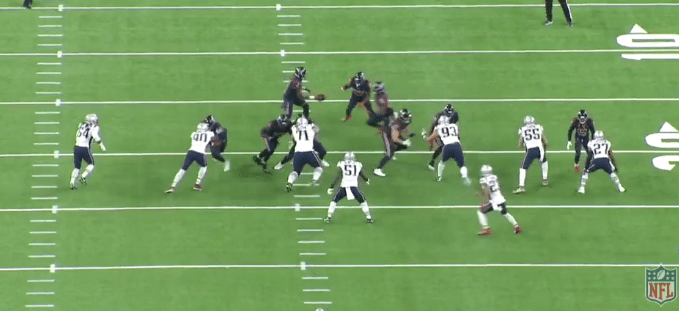
To show some film, look at #71 Danny Shelton here as the head up nose. He plays the center’s block, then feels the guard on him. He throws his hips into the guard, and trades 2 for 1.

Defensive lineman have to play the man on them, while being able to see into the backfield to see where the ball is going. Current LSU Head Coach Ed “Geaux Tigers” Orgeron, used to coach the defensive line at LSU. When speaking at a clinic he said “Coach the eyes of your players. Watch what they are looking at. There is no way the defender can knock the blocker on his butt if he is looking in the backfield. The only way the defender can look in the backfield is to defeat the block first.”
Both Jenkins and Orgeron agree that an outside shaded lineman strikes with his inside hand to the breastplate working up to the throat. The other hand goes to the outside shoulder of the guard. If the ball is run in that B gap, that outside shade (3 tech) needs to pull down on that outside shoulder of the guard and shed the block to make the tackle.
Different coaches teach their players different keys to read. Some teach man keys and some teach their lineman to read the leg of the guard, if you are a 3 technique or 4i. If the guar’s leg comes toward you, play lag technique. If he goes away, work down the line of scrimmage, shoulders square to the line of scrimmage.
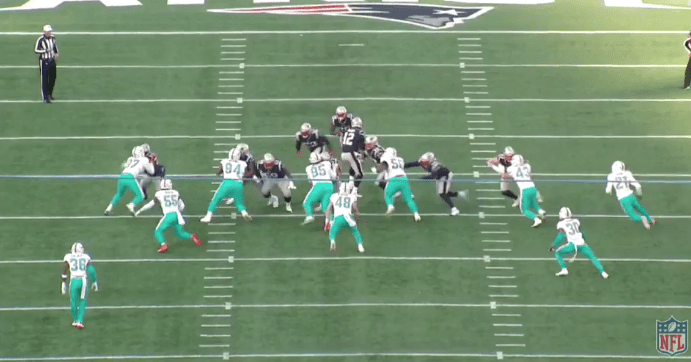
A textbook example comes from #56 Davon Godchaux of the Miami Dolphins. He’s lined up in a 3, and the guard goes away. He chases the hip of the guard, and blows up the play.
Real quick, I almost forgot. When it comes to stance, if you are an outside shade, your inside foot is back and inside hand is down. The opposite is also true, if you are in an inside shade, such as a 2i or 4i, your outside foot is back and outside hand is down.
Defensive line is not a mentally hard position to play, but it is physically hard. They also do the dirty work and do not get the credit or recognition they deserve, in terms of tackles and sacks.
In a nutshell, the key to playing the defensive line is using hands well, having your eyes in the right place, a strong get off, and knowing your assignment.
 Talkin Ball